How it works
Studies keep finding the same thing: when you hand AI the finished answer, the skill behind it quietly fades. Fallow turns that into a garden you can see, tended by Shumbo, your brain pet.
The loop
Type what you were about to ask an AI, or let the browser extension catch it in ChatGPT, Claude or Gemini.
Each ask lands under one of eleven skills, and each skill is a plant: writing is lavender, memory is forget-me-nots, ideas are a dandelion.
Doing the work yourself waters a plant. Handing it off doesn't. Left alone, plants wilt on the same curve memory follows.
Quests point at the thirstiest plants. A short session without the AI waters one, and it perks up.
Shumbo, your brain pet
Shumbo's health is 70% how fresh your keep-list plants are, 20% how much of your last month's asks you did yourself, and 10% your energy right now. If you start handing a keep-list skill off more each week, he drops a stage before the numbers catch up. A brand-new garden starts him at steady, with sprouts.
tap to hopdouble-click to spinhold or rub to pettoo many clicks: dizzy
Today
- Energy comes from the three-process sleep model: how long you've been awake plus your body clock. Set your sleep in Settings.
- Own work is the share of your asks you did yourself or worked through with hints.
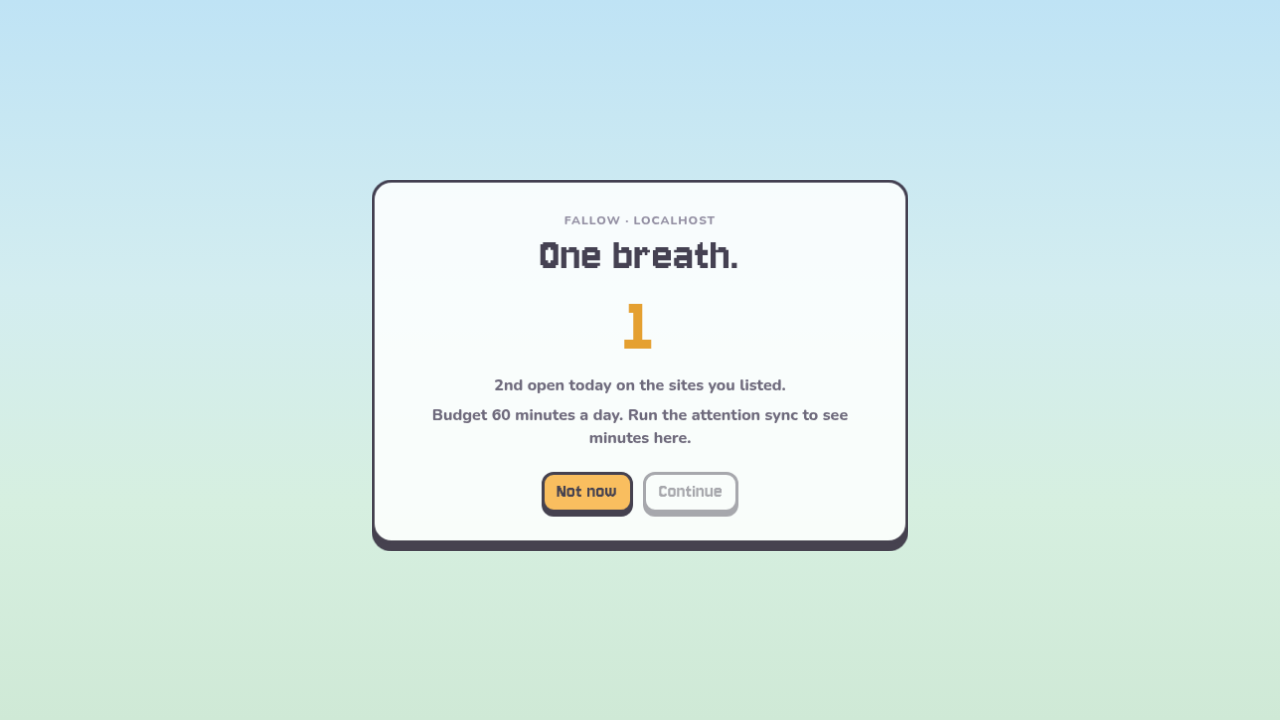
- Screens is time on the sites you list, against your own budget. The extension adds a short pause before they open.
- Focus is your longest unbroken block, from ActivityWatch (free, runs on your computer). Then run
npm run attentionin the local app.
Where the data comes from
Your history. Export it from ChatGPT or Claude and drop it on the Journal. It's read in your browser.
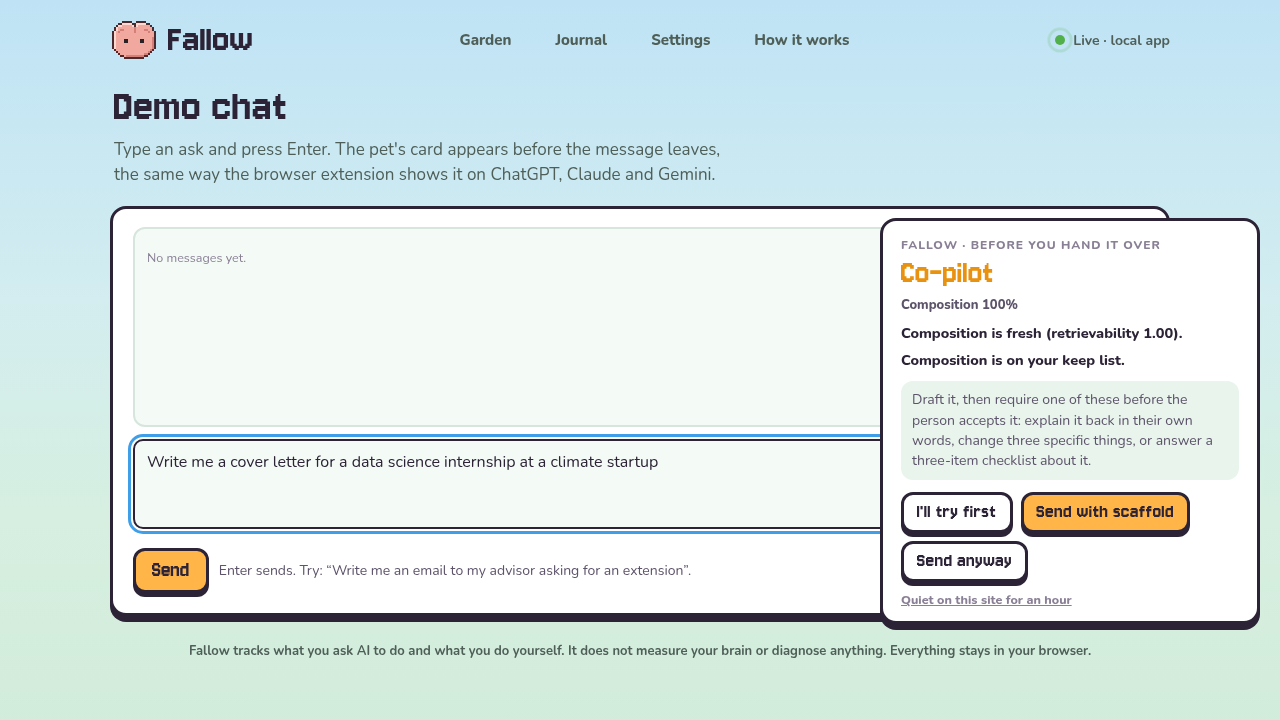
As you go. The browser extension shows Shumbo's verdict before a prompt leaves ChatGPT, Claude or Gemini, and a Claude Code hook does the same in the terminal.
Private by design. The garden lives in this browser (or one file, if you run the app locally). Nothing leaves it unless you sign in.
Sign in to sync. Sign in with Google and your garden follows you to every device, stored in Fallow's free Firebase database where only your account can read it. Plant tags, times and settings sync; the words you typed stay on the device where you typed them, unless you turn on text sync in Settings.
Try the extension's card without installing it: demo chat.
What it does not claim
Fallow measures what you ask, not what your brain can do. It doesn't diagnose anything or predict disease, and the plants aren't brain regions. The decay rates and thresholds are borrowed from memory research or guessed, and the code says which. Whether a dry plant predicts a real drop on a task you do without AI is the first study to run, and nobody has run it yet.
The research
Every mechanism traces to a finding. Open any one.
Handing over the answer hurts; scaffolded help does not
A field experiment with about 1,000 high-school students found that unrestricted GPT-4 access raised practice scores 48% and lowered unassisted exam scores 17%, while a tutor version that gave hints instead of answers kept the practice gains and removed the exam loss (Bastani et al. 2025, PNAS). In a randomized study of 52 developers learning a new library, the AI-assisted group scored 17 points lower on a follow-up quiz, with the largest gap on debugging; what predicted learning was interaction style, not AI use as such (Anthropic 2026). Explanation without a recommendation produced both good decisions and learning; a recommendation with an explanation produced good decisions and no learning (Gajos and Mamykina 2022). Built in: the answer-versus-hint split, and the scaffold mode.
People cannot feel the loss
Experienced open-source developers were 19% slower with AI tools and believed they had been 20% faster (METR 2025, 16 developers, 246 tasks). Confidence in the AI predicted less critical thinking across 936 real tasks from 319 knowledge workers (Lee et al. 2025, CHI). Built in: the ledger is behavioral. Felt effort and self-rated competence are never used as signals.
Skill drifts in months, not decades
Endoscopists’ adenoma detection rate fell from 28.4% to 22.4% in colonoscopies performed without AI after a few months of AI-assisted practice (Budzyń et al. 2025, Lancet Gastroenterology and Hepatology, observational, 1,443 procedures). Students’ prompting profiles diverged within four assignments of a single semester (Misiejuk et al. 2026). Built in: drift detection on the delegated share over four trailing weeks.
Decay is lawful and spaced repetition already models it
Across 53 studies, skill loss grew with the retention interval and was larger for abstract, feedback-free cognitive procedures than for natural or physical tasks (Arthur et al. 1998). Spacing beat massing in 259 of 271 comparisons (Cepeda et al. 2006). Generating an answer beats reading it, d = 0.40 across 86 studies (Bertsch et al. 2007); trying a problem before instruction helps conceptual knowledge and not rote procedure (Sinha and Kapur 2021). Built in: each domain is a card under the open-source FSRS power law, with priors by decay class and attempt-first aimed at conceptual work. Labelled a guess: the priors themselves, which were fitted on flashcards, not skills.
The one earlier offload with a clean cost: GPS
Lifetime GPS use correlated with worse hippocampus-dependent spatial memory, and heavier use over three years predicted steeper decline in a small longitudinal sample (Dahmani and Bohbot 2020). Navigation deficits precede memory deficits in preclinical Alzheimer’s disease, and in Sea Hero Quest genetic-risk carriers separated on wayfinding but not on memory tests (Coughlan et al. 2019, PNAS). Calculators, by contrast, came out neutral or positive in two meta-analyses, and the Google effect failed replication in 2018. Built in: a navigation domain from day one. Left out: any claim about search engines or handwriting.
What depletes in a day is sleep pressure, not dopamine
The three-process model predicts alertness from time awake and clock time with published constants and was validated on 136 airline crew and 8,040 sleepiness ratings (Åkerstedt and Folkard 1997; Ingre et al. 2014). About six hours of demanding work raised lateral-prefrontal glutamate and shifted choices toward low effort in one study (Wiehler et al. 2022). The daily willpower tank did not survive replication: d = 0.04 across 23 labs and d = 0.06 across 36 (Hagger et al. 2016; Vohs et al. 2021), and dopamine does not drain when you avoid stimulation. Built in: the three-process curve with a chronotype shift. Labelled a hypothesis: the fatigue term. Left out: any dopamine variable.
Push-back that works comes before the answer, and people like it least
Cognitive forcing functions cut overreliance on AI more than explanations did, and “people assigned the least favorable subjective ratings to the designs that reduced the overreliance the most” (Buçinca, Malaya, Gajos 2021). Explanations reduce overreliance only when they make checking cheaper than deferring (Vasconcelos et al. 2023). Built in: the verdict before the send, a verification checklist in co-pilot mode, user-set intensity, and a quiet switch.
Screens: friction works, locks do not last
A breathing pause before an app opened led people to close it in 36% of attempts and cut openings 57% over six weeks (Grüning et al. 2023, PNAS). Reviews of digital self-control tools find short-term reductions and no lasting habit change from blocking (Roffarello and De Russis 2023). Switching between videos to escape boredom makes people more bored (Tam and Inzlicht 2024). Office workers took about 25 minutes to return to an interrupted task (Mark et al. 2005). The media-multitasking literature is small and contested. Built in: the pause, a self-set budget shown rather than enforced, switches per hour reported as behavior. Left out: any claim that screens damage attention.
Brain health: maintenance, never detection
The 2024 Lancet Commission names 14 modifiable factors accounting for up to 45% of dementia, as a theoretical ceiling (Livingston et al. 2024). The best multidomain trials show differences of 0.02 to 0.03 standard deviations a year (FINGER; US POINTER 2025). Young-onset dementia runs about 1 per 100,000 at ages 30 to 34, so a detector for young adults has no predictive value (Hendriks et al. 2021). Brain-training games improve the trained task and little else across 11,430 people (Owen et al. 2010). Built in: the vocabulary of trends and habits. Left out: risk scores, detection, any disease claim, and games.
Brain regions: engagement, not training
Knowing a task activates a region says little about what exercising the region does, because most regions serve many processes (Poldrack 2006). The lateral prefrontal and parietal “multiple-demand” network lights up for nearly any hard task (Duncan 2010). Open resources exist for the mapping itself: the Cognitive Atlas, Neurosynth, and O*NET’s abilities taxonomy. Built in: a one-line group-average note under each domain. Left out: any meter that claims to measure a region.
Built with TypeScript, Next.js, React, Firebase and pixel art drawn as code. Source on GitHub